Hello Reader,
Happy Wednesday. ✨
The public comment windows on the $70,000 OPT fee, the 60-day grace period and H-1B extension reviews have all closed. So what actually happens now? Short answer: nothing is final yet, and nothing has changed for your case today.
Plus: a big court win for international students, a draft Senate bill that would extend EB-5 with tougher rules, where the $100,000 H-1B fee stands, 12 days until EB-5 fees jump, immigration attorney Michael Hendricks on whether you should wait until 2027 to file, and two free live sessions this weekend on the D/S ruling and EB-5 project diligence.
Here’s what you need to know. 👇
🎓 Big Win: Court Strikes Down the 4-Year Cap on Student Stays
|
|
📬 OPT Fee, Grace Period & H-1B Extensions: What Happens Next
|
|
⏳ EB-5 Fees Double in 12 Days. Vet Your Project First
|
The Open Atlas Weekly Bulletin
You're receiving this email as part of the Open Atlas weekly newsletter. Immigration and global mobility can be complex. So every Wednesday, we simplify that by sharing breaking news, free opportunities, & latest trends. If you find value in reading it, forward this to a lucky friend. If this was forwarded to you, get your own here!
Read all the past editions here. 💃 |
Now, onto the newsletter.
📗 Immigration
📬 The Comment Windows Have Closed. Here’s What Happens Next.
Over the past month, we’ve asked you to comment on three DHS proposals. All three windows are now closed:
→ $70,000 OPT fee (closed November 9)
→ Ending the 60-day grace period (closed November 10)
→ Ending deference on H-1B and other I-129 extensions (closed November 13)
What happens now: DHS has to review the comments before it can publish a final rule in the Federal Register. A final rule can match the proposal, change it, or never come at all, and it would normally take effect at least 30 days after publication (60 for major rules). There’s no public timeline for any of the three, and none is in effect today.
What to do in the meantime:
→ OPT students: nothing has changed for your OPT or STEM OPT. Keep filing on your normal timeline.
→ H-1B workers: the 60-day grace period still exists, but don’t build your plans around it. If your job is at risk, start your transfer or change of status early.
→ Filing an extension? Treat it like a brand-new case and include full documentation, whatever happens to the deference rule. More on this from our Expert Take below.
👉 Track the H-1B extension rule on regulations.gov
⏳ 12 Days Until EB-5 Filing Fees Nearly Double
Final reminder: any EB-5 petition postmarked on or after November 30 pays the new fee. For regional center investors, the I-526E fee rises from $3,675 to $7,850. If your documents are ready, filing before then saves about $4,000 per petition.
👉 Read the final rule in the Federal Register
🏛️ Draft Senate Bill Would Extend EB-5 to 2032, With Tougher Rules
A discussion draft dated November 12, the EB-5 Recommitment to Integrity and Transparency Act, would extend the regional center program to September 30, 2032. Today it expires September 30, 2027. In exchange, investors would face stricter requirements:
→ More jobs: 15 full-time jobs per investor instead of 10 (12 for rural set-aside visas).
→ Longer hold: 40 months instead of 2 years, with the clock starting only once your full investment is in the project.
→ More frequent price increases: investment amounts would be adjusted for inflation every 3 years instead of 5. The first adjustment would still happen January 1, 2027.
→ Stricter money rules: funds would have to move through regulated financial institutions, projects couldn’t lend investors money toward the minimum, and promoters would have to be named on the I-526 or I-526E.
One line to watch: the draft says the changes would apply no matter when you filed, and it doesn’t spell out any protection for current investors.
What it means for you: this is a draft only. It has no bill number, hasn’t been introduced and isn’t law, and the text could change. Nothing changes for current filings today. If you’re investing, ask your attorney and regional center how a 40-month hold would affect your plans.
👉 Read a full breakdown of the draft
🎓 Students
🚨 Breaking: Court Strikes Down the DHS “Duration of Status” Rule
Big win for international students, scholars and exchange visitors. 🎓 On November 16, U.S. District Judge F. Dennis Saylor IV in Boston vacated, in its entirety, the DHS rule that would have replaced “Duration of Status” (D/S) with fixed admission periods, generally capped at four years. The court found the rule arbitrary and capricious under the Administrative Procedure Act. The rule had already been blocked since September 14, so it never took effect.
What the rule would have done:
→ Capped stays at a fixed term instead of the length of your program.
→ Restricted transferring schools and changing educational objectives.
→ Cut the post-graduation grace period from 60 days to 30.
→ Required formal extensions through USCIS.
What it means for you:
→ D/S stays in place. F-1 and J-1 holders continue to be admitted for the length of their program, and the 60-day grace period still applies.
→ Nothing to file. You don’t need to take any action because of this ruling. Keep maintaining your status as usual.
→ It could still change. The government can appeal and ask for a pause, but an appeal alone doesn’t suspend the ruling. We’ll share updates as they come.
Want to go deeper? Michael Hendricks breaks down the ruling live this Friday, November 20. Details below. 👇
👉 Read the case updates from the Presidents’ Alliance
⚖️ CPT Case: Still Waiting on a Ruling
Twelve days after the November 6 hearing in Boston, the judge still hasn’t ruled on the universities’ request to pause SEVP’s August CPT guidance, and no date has been set. That means the guidance stays in effect: schools should only approve CPT when the training is required of every student in your program.
→ Lining up a spring internship? Check with your DSO before you accept an offer, and get any CPT approval in writing.
👉 Follow the case on NAFSA’s litigation page
💼 Careers
💵 The $100,000 H-1B Fee: Still Not Being Collected
Two federal courts have now blocked the $100,000 payment on certain new H-1B petitions: one in Massachusetts in June and one in California on September 30. USCIS has said it will follow the court orders, so employers aren’t paying it right now. The government is appealing, and a September proclamation tried to extend the fee through September 2027, but the California ruling blocked the agencies from enforcing that extension too.
Separately, DHS has proposed a different $103,265 fee for cap-subject H-1B petitions. That one is only a proposal and isn’t in effect.
What it means for you:
→ Job hunting? If a recruiter says sponsoring you now costs $100,000, that’s not accurate today. The fee was also aimed at new petitions for workers outside the U.S., not people changing status from inside the country.
→ Watch the appeals. The litigation is ongoing, so this could change. We’ll flag it here if it does.
👉 Read USCIS’s H-1B page
🎙️ Expert Take
What the Midterms Mean for Your Case: 5 Questions, Answered
Last Thursday, we co-hosted a live session with Legalyti on what the 2026 midterms mean for high-skilled immigrants. You came with great questions. Here are the top five, all answered by Michael Hendricks, immigration attorney and founder of Hendricks Law, who also serves as compliance attorney for Legalyti. Answers are paraphrased for clarity.
Q: "Should I wait until 2027 to file my EB-1A or marriage-based green card, in case the new Congress makes things easier?"
No. Congress doesn’t control how USCIS decides cases; that’s the executive branch, and the law itself hasn’t changed. If you’re waiting for a friendlier review climate, you’d realistically be waiting until after the 2028 presidential election, so into 2029. If your case is ready, file it.
Q: "EB-1A approval rates have dropped a lot. Will that change after the midterms?"
Not because of the midterms. USCIS sets its review standards under the President, not Congress. Hendricks thinks the agency has over-corrected: every one of the roughly 30 EB-1A petitions he filed in the past six months got an RFE, including some very strong cases. His advice: prepare thoroughly and be patient, even if building your profile takes months or years. Don’t hold evidence back to save for an RFE, and don’t bury the officer in paper either. Send what’s relevant.
Q: "Should I pay for premium processing on my EB-1A or NIW?"
For a standalone EB-1A, he generally recommends regular processing. A 15-day deadline can push officers toward broad “kitchen sink” RFEs, while regular processing gives you more time to prepare a strong response if one comes. For an NIW, premium doesn’t change your priority date, so it’s often money spent to hurry up and wait. One exception: if you need the approval to extend your H-1B past six years, you can upgrade to premium later.
Q: "How do I find employers that are genuinely willing to sponsor an H-1B?"
A company’s history of H-1B filings is still the best signal: employers that have sponsored before generally keep doing it. Job posts that openly say “visa sponsorship available” are the exception, not the rule. If an employer is nervous about the $100,000 fee, remind them it isn’t being collected right now and was aimed at new petitions for workers outside the U.S.
Q: "Can the new Congress stop the plan to end deference on H-1B extensions?"
Not directly. It’s an agency rule, and the midterms don’t change agency rulemaking. His bigger point: never count on deference anyway. File every extension as if it’s a new case, with tax records and any other supporting documents. Congress does have some levers, like oversight, confirmations, funding and narrow new laws that can override a policy, but they’re smaller than many people think.
These answers are general information and are not legal advice for your specific case.
Want more from Michael? He’s back live this Friday to unpack the D/S ruling. Details below. 👇
🗓️ Join Us Live
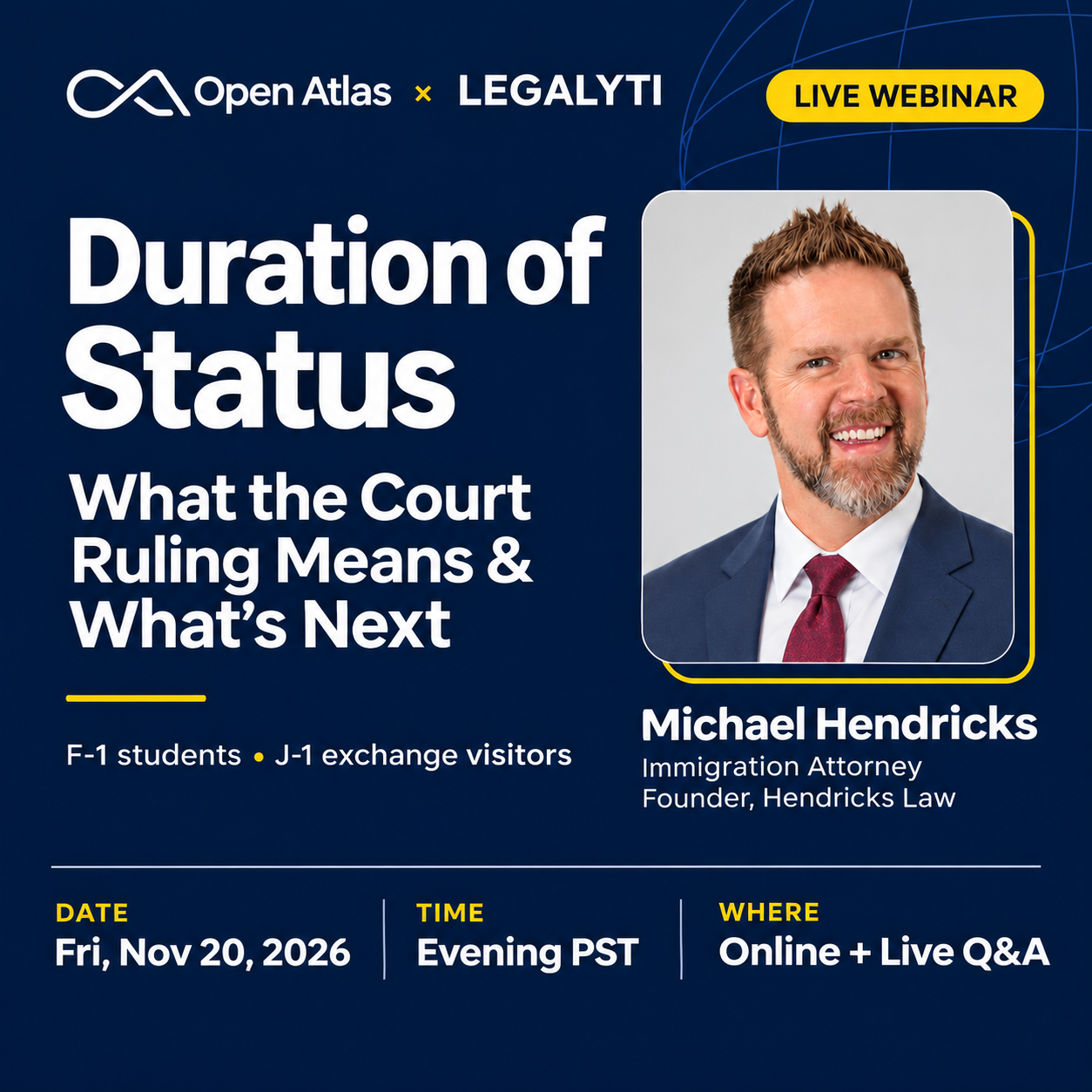
Duration of Status: What the Court Ruling Means & What’s Next
📍 Friday, November 20 · 6:00 PM PT / 9:00 PM ET · Zoom · Free
Monday’s ruling keeps D/S in place, but what does it actually change for you, and what could happen next? Immigration attorney Michael Hendricks, founder of Hendricks Law, breaks it down in plain language. Co-hosted with Legalyti.
What we’ll cover:
→ What the court decided, and how it differs from September’s temporary block.
→ What stays in place under D/S, including transfers, program changes and extensions.
→ Questions to ask before making decisions about your studies or exchange program.
→ What could happen next: appeals, requests to pause the ruling and future DHS action.
→ Live Q&A with Michael.
Who should attend: international students, exchange visitors, researchers, university staff and anyone supporting someone on an F-1 or J-1.
👉 Register for the November 20 webinar
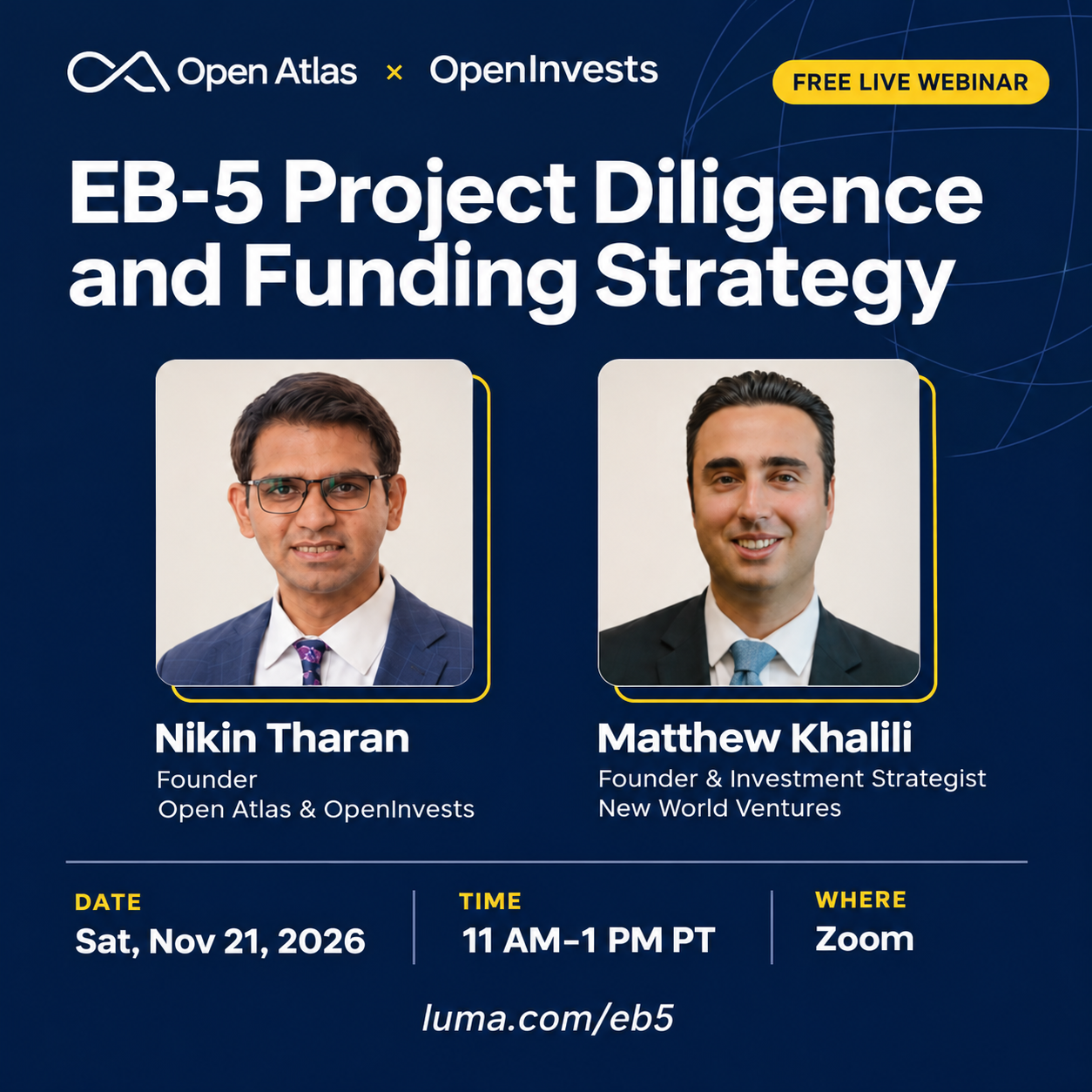
EB-5 Project Diligence and Funding Strategy
📍 Saturday, November 21 · 11:00 AM–1:00 PM PT / 2:00–4:00 PM ET · Zoom · Free
Choosing an EB-5 project and deciding how to pay for it go hand in hand. In this two-hour session, Nikin Tharan (Open Atlas & OpenInvests) and Matthew Khalili (New World Ventures) walk through how to evaluate a project and plan your funding. Co-hosted with OpenInvests.
What you’ll learn:
→ Project diligence: reviewing the capital stack, loan priority, developer equity, collateral and guarantees, plus the developer’s track record and job-creation estimates.
→ Repayment: how to assess repayment plans, loan extensions, prepayment and redeployment.
→ Funding options: comparing savings, asset sales, HELOCs, securities-backed lines of credit and other borrowing, and the tradeoffs in cost, collateral and timing.
→ Source of funds: planning your documentation and tracing the money with your immigration attorney.
→ Live Q&A.
Who should attend: prospective EB-5 investors comparing projects, families weighing EB-5 as a green card path, and anyone whose capital sits in property or securities.
👉 Register for the November 21 webinar
This webinar is for educational purposes only and is not investment, financial, legal or tax advice, or an offer to buy or sell securities. Investments involve risk, including loss of principal.
🤝 Need one-on-one visa help? Visa Architect offers personalized visa consultations to help you map out your options and next steps.
👉 Book a consultation with Visa Architect
👉 Want to put yourself in front of 52,000+ high-skilled immigrants? Just hit reply to start a conversation.
Until next week, stay awesome.
Yours truly,
Team Open Atlas 💙
💡 None of the information shared in this newsletter is meant to be legal advice. If you're looking for legal advice, speak to a lawyer.